Showing posts with label radio. Show all posts

06 July 2012

Mouse Jockey

Back from a longer absence than we care to admit, the Peanut Whistle blogger is catching up to all the new ways of doing things in radio. Back in the dark ages we had separate machines that had specialized tasks. Tape machines, record players, live sources: all compartmentalized and each one doing its job very well.

Now days computers and highly complicated software have replaced both physical machines and human beings. Don’t get me wrong, I am no Luddite. I have always embraced new technology. In fact, you could call this blogger an early adopter.

What I take issue with is that we now over rely on one central computer to deliver all our content. There is no safety net anymore. No back up. Newbies to the business are not trained on legacy equipment, so they’re lost when the software crashes. With no physical interaction with our playlists, they’re screwed if something goes wrong. A computer mouse makes a poor replacement for a cart tape machine.

To me the term disk jockey is passé. To this generation the Peanut Whistle proposes a new handle: “Mouse Jockey.” Although getting a saddle on those critters will be tough.

Stay tuned.

02 July 2012

A.W.O.L.

So the Peanut Whistle blogger has been missing in action of late. With the best of intentions, our little blog has been overlooked due to my real world engineering demands. That, of course, is a good thing. Right now we are in the midst of rewiring our control room. The current wiring is, ahem, substandard: pro XLR connections improperly adapted to consumer RCA hookups, bad wire splices. It’s all in a day’s work.


The “Hi-Fi” project is over. We’ll make a return to that subject in a future post. You will be surprised at the results: guaranteed!

Stay tuned

31 May 2012

Audio Band-Aid

Sometimes in the field, one has to improvise. Lately the Peanut Whistle blogger has found himself seeing this in practice. Our latest venture at the new radio station involves a funny contraption that reminds this blog of a Rube Goldberg Machine.

We were called to fix the audio from the control room computer. It runs a version of Adobe Audition that is used to record satellite shows for later broadcast. The audio into and out of the machine was distorted—badly. Prior to the Memorial Day holiday, it was imperative that we get the audio fixed. Toolkit in hand, the hunt began for the gremlin that invaded the board, once again.

The console is an ancient, but serviceable,  mono 10-channel rotary pot LPB Signature III that has extra inputs on select channels. For whatever reason, previous engineers had placed conflicting sources on the same pot. For example, the Enco DAD presenter feed was on the same switch as the satellite feed. That was corrected.

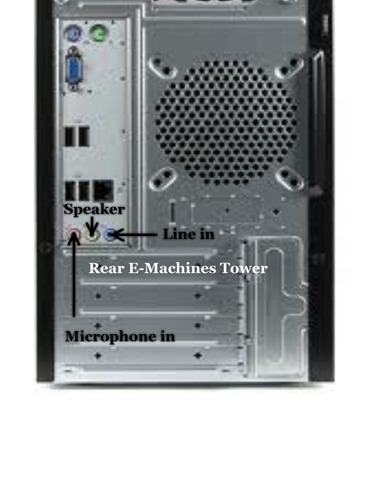
First thing, the Adobe Audition computer, an E-machines brand, was rerouted so we could eliminate possible crosstalk. That was not the problem. The wire pulled away from the source and it was discovered that the computer tower had been placed on the floor! A great location for board ops to kick it. The audio was coming from the soundcard port on the back of the tower (arguably, not an ideal pro connection.) The speaker port had been damaged inside, as well as the odd jack and assorted adapters. A 1/8” to 1/4” stereo phone plug adapter into a 1/4” phone to stereo RCA phono plug, then into a stereo to mono y-adapter and finally an RCA cord to the board. No wonder the jack had been damaged; all the length and weight not only had bent the 1/8” plug, the jack on the sound card had been virtually hollowed out. (See the photos below)
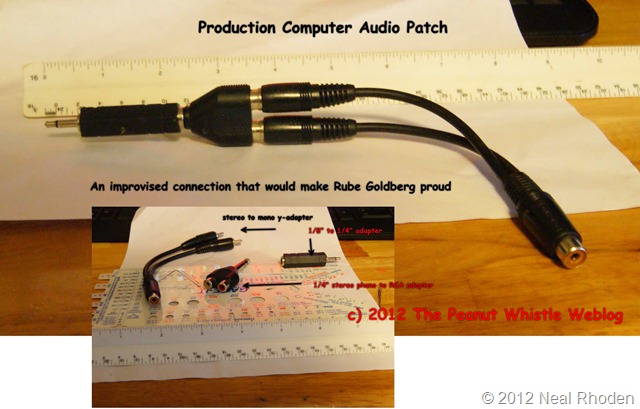
Audio Patch

Emachines Rear Tower

In the example above, we recreated the adapter “pigtail” with a mono phone adapter, otherwise, it is the same as the studio’s.

The repair session took place afterhours and Radio Shack was closed. Bummer, so we frantically rummaged through the parts attic and found a new mini-plug in a plastic bin full of random electrical stuff. This was lucky, to say the least.

After recreating the improvised circuit, the connection had to be replaced to the front of the computer where an extra speaker terminal was placed (more good luck.)

Levels had to be tweaked in Windows. The line in jack, although noisy due to electrical and RF interference, was okay, required electronic adjustments as well. Oddly enough, the connection from the board was a straight wire, terminating in a mini-plug (1/8”). A return trip is guaranteed. The repair is only a Band-Aid. Next we will relocate the E-machine higher and provide a USB interface with pro XLR and RCA connections for a noise free balanced circuit.

Stay tuned.

30 May 2012

Hear Me Now

Telephone hybrids are a godsend. What they do, to you less technical types, is separate audio. They are especially useful in talk radio formats. When a listener calls a radio station the sound of his voice is sent along  a path from the phone line to the “hybrid” to the “board”. This little black box keeps the phone sound from looping thus causing feedback while at the same time sending clean audio to the caller so a meaningful conversation can ensue between host(s) and caller.

My new station had been experiencing problems. Callers were getting terribly distorted audio from the studio. Two way communication was impossible. This had remained unrepaired for a year. The station had recently flipped to a Progressive Talk/brokered time/Gospel music hybrid (pun) and were past due a fix. That’s where I came in.

DSC01434My 8 year old son (pictured, left) and I found the station in a strip of offices about 45 minutes from our home. My old radio friend is now the GM.

That first try was my engineer test, apparently. Taking about two hours of tracing wires, trying a spare hybrid (which worked, kind of), then reassigning board inputs. Nothing satisfied me until I noticed on the back of the Telos On-x-Six Telephone Hybrid (now reinstalled), an inconspicuous switch. telos back panelA mic-line level switch (above) set on “microphone level”. Oops! An entire year and no one had noticed. Could this be the problem? Sad to say, it was. My lesson for next time: check this switch first. What my son would call a duh moment. Next time I will look at my latest engineering challenge: computer audio running Adobe Audition.

Stay tuned

29 May 2012

Return to Radio

I have been busy lately. That’s news, both good and bad,  for the Peanut Whistle.
When it seemed that my former career had come to an end, opportunity called—literally.
  Some quick background: I began a 12 year career as a disk jockey exactly 29 years ago today (May 29, 1983). By 1995, I left broadcasting for a more lucrative endeavor—retail store management. My passion for those days were buried until one day in 2008 a dreadfully boring job ended and I began writing about and researching my old life. It became an obsession that, by 2012, culminated in yet another burnout. I had overloaded myself—this blog became one of four I wrote, plus my book still in the works.
Back to the present. My old station manager phoned me in June of 2011, while  my family and I were vacationing in Florida. We had just entered the gates of marvelous Sea World Orlando when my cell rang. The voice on the other end was unmistakable; She and I had worked together in my formative years at my first radio home in historic Savannah, Georgia. My old friend needed an engineer pronto and thought I could recommend someone in the Atlanta area—my home for the last 26 years. She was in town helping out our former bosses, once owners of a regional radio empire with stations from Memphis to Miami. They had sold off almost all of their properties (including our old AM/FM in Savannah in 1998). These owners now retained only Atlanta and Valdosta in the great state of Georgia. Poor timing notwithstanding, I gave her a name from my past, the only engineer I could remember by name. It never crossed my mind that I might be considered a contender for the task.
Over the next several months we corresponded via e-mail and Facebook, never quite able to mesh schedules. The Atlanta station was a 50,000 watt daytimer with the same owner since its inception in 1947. Back in 1986, when I moved from Savannah to Atlanta, my station offered transfer there. I didn’t take the job and wound up at a 5,000 watt church owned Christian station. Long story short, I finally toured the facility on May 8th (a quarter century later). My friend is now general manager. To be kind, they have some technical issues.
I’ve said all this as introduction to my next blog series—a worm’s eye view of radio or my new gig as consultant slash engineer for a true diamond in the rough and how I intend to bring back and maintain the equipment. The format is someone else’s concern, for now…
Stay tuned.

01 August 2011

Bailing Wire and Duct Tape

Two years ago I posted Beam Me Up Scottie. It was about a the raggedy little 5kw radio station where I got my start as a disk jockey and button-pusher. There we faced numerous challenges, including frequent power failures due to thunderstorms; so frequent, in fact, that one of my associates on the FM side once quipped, “someone could pee down the street and we’d go off the air.”

I never quite figured it out. I don’t believe that our chief engineer was necessarily bad. The owners were cheap.

Case in point: one time our studio location (not the tower site) had a power failure that would have crippled us for several days. Our engineer remedied the situation by installing a generator. The problem was that he had to use a very small gas powered affair that was more suitable for a campsite rather than all our office lights and equipment. Every time I played a commercial from a cart machine the audio was comically slowed down and the lights dimmed (the electrical load was just too much for the little putt-putt generator.)

Like a surgeon forced to use a butter knife, our engineer did the best he could with the resources our frugal owners provided.

Stay tuned.

03 May 2011

Restomod

I was inspired by car restoration hobbyists for my most resent idea: “restomod.” You see, some people actually have enough cash to turn a junk yard jewel (hint: sarcasm) and transform it into a true classic. Rust buckets all over the world have be resurrected. Purists insist on ground up restorations with “numbers matching” parts. In other words, these cars are returned to factory fresh condition with original parts.

Another camp of car enthusiasts subscribe to a different philosophy—modification and restoration or restomod. Basically, they obtain a donor car (usually just a body) and build it up with modern high performance parts. The resulting car winds up resembling the original, but it drives, handles, and performs on par with modern state-of-the-art vehicles.Spotmaster Board WEAS

On to my idea. This combines two of my passions, cars and broadcast radio equipment. What if I find an old fashioned radio mixing console, gut the electronics and replace them with today’s best professional audio components. Most of those old boards were very roomy inside, like a ‘57 Chevy, and would lend themselves to extreme modifications. The exterior would be restored to original factory fresh appearance and function; the best of both worlds, classic ergonomic design with stellar 21st century sonics.  I would fill my fantasy studio with such equipment, like the console pictured above. It’s an old Broadcast Electronics Spotmaster, the one I learned on. It was maintenance deferred, sounded like crap, but was easy to “drive.”

Recently, I stumbled on a guy who has done this. Here is a link to the site for photos and more information.

Stay tuned

© 2011 Neal Rhoden. The Peanut Whistle Weblogs. All Rights Reserved.

28 April 2011

Audio Alchemy

During my first 4 years in radio I worked in a studio wired for monaural sound only. Stereo aircheck recording was not feasible with the available equipment. However, in 1985, I used a small “disco” mixer to make stereo mix tapes for personal use. Previously, I experimented with re-routing the left and right outputs of a single turntable to the two mono pre-amps then into program and audition respectively; successfully recording in stereo. This method was cumbersome because the left and right inputs were controlled by two separate knobs on the board (one routed to audition, the other to program.)Independent Stereo Recording Circuit

The studio’s Technics SP-15 turntables audio cords were re-routed from the usual phono pre-amplifiers to the small (cheap) stereo mixer. The diagram on the right is a speculative idea of what if I had used this set up to record an actual aircheck. Using this type mixer would have been real world challenging due, in part, to its inability to switch on and off monitors and microphone.

By 2009 I had the ability of digitally isolating the live vocal portions of my original aircheck recordings and carefully synchronizing in stereo music from CD’s and other digital files (mp3, wav, etc.) It was impossible to remove all unwanted mono audio. Some “phasing” between the new stereo and old mono occurred.

Alternate Signal Path Independent RecordingWith this in mind an alternate wiring path would have been preferable for future “stereo rebuilds”. The simple diagram to the left illustrates an easy method of electrically isolating the DJ microphone from the (mono) music and other prerecorded elements of my shows. The isolated vocal tracks could have been later used to assemble a true stereo mix, either analog or digital.

Stay tuned

©2011 Neal Rhoden. The Peanut Whistle Weblogs. All rights reserved.

26 May 2010

Radio Reflections

The author c.1987
Reflecting in 2010 on the state of what was I feel quite fortunate to have worked in the radio broadcast arena when I did.

Today radio has become irrelevant. I've covered this topic many times in the past on the Aircheck blog; so, I don't feel it necessary to go down that road once more today.

Often when one's supposed purpose in life is questioned a change of season or scenery is in order. In 1995 I had already spent 12 years of my life in broadcasting in virtual anonymity and felt that I had done all I could do in the field and escaped to 13 years in retail never seriously regretting my decision in light of financial reasons not due to any love loss.

Someone influential in my formative years warned that, "Once radio gets in your blood it is impossible to cure." He was right. But, what choice does one have once bitten by the "Radio Bug" when the whole industry has been turned on its collective ear?

The answer: redefine the skill set and adapt in a 21st century setting.

Again, I believe that my generation of broadcasters were the last of the breed anchored in the heritage of the medium while yearning for the new digital technologies so common today. The same technologies that have killed radio as we knew it. Rest in peace Radio.

Stay tuned
©2010 Neal Rhoden,The Peanut Whistle. All rights reserved.

18 May 2010

Today's Radio Rant

Mark Twain once quipped, "The reports of my death have been greatly exaggerated," after his premature obituary had been published in the New York Journal. His exact quote has been a matter of academic contention over the years but I quote (or paraphrase) him today to prove a point about radio.

Reading the radio trades these days can be a bit discouraging; they're constantly reporting its demise, especially in Internet forums. They bemoan the corporate take overs, the absence of local talent with hometown appeal, and lack of public interest as causes. While these are valid arguments, radio isn't dead -- yet.

My podcast hobby has been a mostly effective panacea for my radio jones; much like reading about the Superbowl and actually being there, my hobby pales next to the real thing. I'm strictly an armchair quarterback. In fact, hordes of radio people with more marketable resumés are unemployed or in unrelated fields now.

Surely careers have died, but the industry as a whole will continue to exist--only in a different form. Music and information will be delivered in a way unknown currently to AM, FM and even TV professionals. The recent switch to digital TV from analog last year is only the beginning of change. Traditional radio is on life support; but, I'm afraid as soon as cheap (or free) high speed wireless Internet is available to the masses (on a scale equal to the ubiquitous transistor radio of old) the plug will be pulled.

In other words: the end will be when these new media technologies are truly mobile and free everywhere, just as radio has been for generations.

I believe my anonymous grandchildren will witness this event in their lifetimes. However, this grim prognosis was forecast when television debuted in the late 1940's. MTV threatened in the '80's. Radio kept on kicking. Bottom line: who knows? Like the Digital Mandate illustrates, our government authorities will continue to press us all into the 21st century like it or not. Radio is not immune.

Stay tuned 
©2010 The Peanut Whistle. All rights reserved.

13 January 2010

Pandora’s Box

  Many music fans with high speed Internet already know of the vast streaming audio choices the web offers. Today I am listening to Pandora radio. The service is awesome and it is free; you can tailor according to your own tastes. Type in your favorite song or artist and, voila, it chooses a mix of selections especially for you with very minimal ads. To me; as soon as most Americans have a computer, Wi-Fi or WiMax receiver or web enabled cell phone, traditional radio is dead. That may be sooner than most people think. I hardly ever listen to AM or FM for anything more than news or the occasional talk show. I suspect many others have similar listening habits. Unfortunately, the market cannot withstand the infinite choices available and needs to be sifted because no company can make money when the audiences are so diluted. When any average 16 year old can start an on-line radio station in his basement and can pull away just one listener from more traditional media who knows what kind of Pandora’s box we’ve opened.

Stay tuned

copyright 2010 the Peanut Whistle. All rights reserved

28 November 2009

1980's CCM Spec Show

©2009 The Peanut Whistle. All rights reserved.


  I had so much fun with the music in this show from the late 80's. Contemporary Christian Music was worlds apart from today's counterpart. Listen as I echo the then popular CHR format in this unscoped gem from 1987 that was done in my Atlanta studio at radio home number two. This recording did not air on any radio station and was only intended to be a speculative demonstration of the J900 format I invented at my original radio home. The idea has not been presented unedited until now. Enjoy.

Stay tuned.

21 August 2009

Gran Torino

Long before the 2008 Clint Eastwood movie of the same name I owned two of them. I am speaking of the Ford Gran Torino. One a 1973 four door station wagon olive green with fake wood side panels that I drove most of the 11th and 12th grade. I went everywhere in that thing; assisted my dad in his piano tuning business, drove him to church trotted off to his preaching engagements and in later years to my job at WEAS. The thing looked like a tank and finally died when I lost the transmission in it.

Next was a tomato red two door Starsky and Hutch special. I loved that car. Unlike the TV show which featured a ‘74 model mine was a ‘76 without the broad white racing stripe. I had bought it from my station manager for a $1,000.00 and she let me make payments of $50.00 a paycheck. Good job security I suppose. I kept it detailed and made the local Western Auto my second home. One Sunday after church, I wrecked my baby by rear-ending a black Trans-Am or Camaro similar to the Smoky & the Bandit car Burt Reynolds drove. There was hardly a scratch on the car I hit. My eight year old beauty sustained major front end damage. The plastic grille was smashed along with a huge dent in the right front quarter panel. The one and only body shop estimate I got was for $1,200.00. Oh my God! 200 more than I paid for it. To top things off I was ticketed for driving too close, made a court appearance and covered the $50.00 fine. Unfortunately, I didn’t have collision insurance or $1,200.00 so I had to drive her wrecked.
 

Despite all the cosmetic flaws, I kept the Torino running good. I had a great honest mechanic at the Ford dealership who would do maintenance and repairs on his lunch break and charged me cost for the genuine Ford parts. I learned a lot about cars from this veteran wrench turner. He was a master diagnostician who seemed to know everything. God places the right people in your path.

I, on the other hand, was a complete novice. I bought a cheap Western Auto ratchet set and got started making repairs on a trial and mostly error basis with a Chilton’s manual by my side. One day I decided to remove the non functioning Eight Track stereo. Hey, I worked at a radio station so this should be reasonably easy. Right? I exorcised the unit and left a yawning hole in the panel which was never filled with a new radio. My dad ribbed me constantly for my amateur surgery. The patient did not survive. As a substitute I took along a Sony portable radio for musical accompaniment and news on the 30 minute ride to work every day.

From that point forward I decided to learn all I could about cars; their intricate electrical systems, ignitions, and parts. Self education paid off later in life when I embarked on a lucrative 13 year career in auto parts following my life in radio; obtaining an ASE certification along the way, all thanks to my initial tinkering with the Gran Torino.

Stay tuned.

11 June 2009

King of all Peanut Whistles

Talk about a peanut whistle. I worked a year at this particular 2,500 watt gem. We had local news, Southern Gospel music, a Swap Shop and daily obituaries. The news wasn't from a teletype or our own reporters. No, we read it directly from the newspaper. Verbatim. A few years before the dot com boom one of my fellow staff members commented on the state of our programming. The idea of a good ole country station was a relic of a bygone era. The world was now more accessible thanks to new technologies. I don't agree with him totally because stations such as this have their own unique charm. My friend Jim did get it right on one point though, we are a more enlightened society thanks to outlets such as CNN and other TV cable networks readily available then. It was 1992 and the World Wide Web and Fox News were a few years off. The context of his remarks was framed by people who he had observed overstating their "country" heritage by feigning ignorance, although being just as enlightened as city folks.

I was a bit of a snob then and saw this station a road block in my career.  The WBKI culture was an adjustment and was a step down from a purely business perspective. I later adopted their style and grew to appreciate their way of doing things. A few of the more countrified elements were weeded out and we became more "sophisticated." The home spun morning DJ resigned shortly after some heated debate with me. I viewed him as a local yokel. He was blissfully ignorant but the people loved him. The station fell into decline and eventually folded. My guess is that we didn't give the listeners what they wanted or maybe poor management was to blame. Who knows? Our GM saw the futility of the situation early on and probably mentally quit long before our demise. To borrow from the famous TV show WKRP in Cincinnati this guy was "town to town, up and down the dial". Success eluded David. We had worked together before. I witnessed his slow decline at my previous radio gig and now doubt my own wisdom in hitching to his star. However, I learned a lot from him and consider him a mentor. He allowed circumstances to limit him. I missed the control I had as a program director at my two previous jobs and felt the air chair was a handicap. For the first time in 6 years I was "just" a dee jay.

Stay tuned!

04 June 2009

What's a peanut whistle?

I'm glad you asked. A peanut whistle is a radio station with limited power or listenership or both. It might have the best staff or talent but simply lacks enough umph to reach a broader audience. These media outlets are usually located out in the sticks. These are the places I've hung my hat as a DJ and programmer most often. I've led some very talented people. Some great and near great talents. 

These places are usually programmed for a rural audience. So, I'm not sure if they exist at all any more due to the consolidation of ownership permitted by the Telecommunications Act of 1996. The FCC decided to allow ownership of several radio or TV stations in one market. Large corporations have gulped up these peanut whistles at an alarming rate. It wasn't video that killed the radio star, it was corporate greed. More to come. Stay tuned...

Labels

1980's (1) 1983 (1) 1984 (2) 1990 (2) 1991 (2) 1992 (1) 2010 (3) 2011 National Quartet Convention (3) 75 (1) 8 track (1) ABC (2) american (2) analog sound (2) audio (7) awesome Gospel airchecks (4) Bill Gaither (1) birthday (1) blogging (13) Bluetooth (1) bologna (1) book diary (1) Brad Paisley (1) Breakfast with Burl (3) Burl Womack (3) Career achievement award (2) career choices (3) catholic (1) CCM (7) Chris Watkins (1) Christian Country (1) christian scandals (1) church (2) church culture (2) Classic Imperials (1) computers (1) consolodation (1) country (2) Country music (3) crossover (1) Dennis the Menace (1) depression cure (2) digital (2) Digital vs. Analog (1) Dixie Melody Boys (1) DJ (5) Dogs (1) economy (2) electronics (5) Elvis (2) exercise (1) Facebook (2) family history (1) family life (19) FCC (1) football (5) Ford (1) Foreigner (1) Fun (1) Gaither Vocal Band (1) Garden City Georgia (1) general store (1) Georgia Radio Hall of Fame (1) Gospel music (8) Gospel Rewind Radio (2) gramophone records (1) Gran Torino (1) Grin Radio (1) Halloween (1) health (1) history (1) Humor (4) Imperials favorite group (1) impractical ideas (1) insomna (1) Internet (4) Internet radio (4) Irish (1) J900 (1) kids (2) Let's Make a Deal (1) Lulow Porch (1) marketing (2) modification (2) network news (1) New media (3) New Year (1) Novelties (1) Paul Harvey (2) peanut whistle (8) podbean (1) podcast (1) podcasting (1) pop history (5) programming (3) psychology (1) radio (15) radio history (31) radio production notes (3) random (2) restoration (5) retail (1) Rock music crossover (1) rural (1) Saint Patrick's Day (1) Satire (1) Savannah (5) Savannah Skate Inn (5) Skate culture (3) small market radio (3) small town (2) small town radio (7) society (3) southern culture (11) southern gospel (7) Sports-Talk (1) talent (3) technology (17) Telecommunications Act of 1996 (3) telephone (1) television (2) The Beatles (1) Tiger Woods (1) tour (2) TV (2) video (1) vinyl (2) WBKI (2) WDCY-AM (2) WEAS (7) weather (1) Wendy Bagwell (1) WGUN-AM (1) whimsy (1) Winans (1) WKRP in Cincinnati (2) WNMT (1) woodworking (4) work (2) WSB-AM (1) WSPZ aircheck (1) WWJD (4) WZAT (3) YouTube (3) Z-102 (3)